|
||||||||||||||||
 |
 |
|
||||||||||||||
|
|
|||||||||||||||
|
"By having these simple conversations with your soma, you recondition habitual stress responses, and dissolve the static tension so many of us live with and unquestioningly accept as irrevocable. You can take control of your well-being and let your body feel its own pleasure and ease more often." |
The Five Technologies of Somatic Expression
I have been teaching movement-based work for the past twenty-five years, and have accumulated many diverse techniques and tools along the way for working with the body somatically and expressively. For some time, my students in the US and Europe had encouraged me to write about my way of working, so I finally set off on an extended sabbatical in 2000 to examine what I knew, what I taught, and what I actually believed could make a meaningful contribution to the field of somatic-expressive education. This self-reflection initiated a substantial re-visioning of my work once I began to consider some primary questions: What are the underpinnings of all these different movement forms and approaches? What does nature implicitly give us as human animals for health, well-being and pleasure? And how can we remember and activate this inherited vocabulary consciously? As I sifted through my experience and the teachings of other somatic theorists, I identified five indigenous technologies of the body that give us the ability to communicate pre-verbally both internally and externally. These five technologies are:
Each somatic method utilized these five in varying degrees depending upon their orientation and intention. Underneath all the specialized forms is a subterranean layer of generalized resources that form the infrastructure of the healthy human animal. After identifying this universality, I was able to translate these five technologies into activities for everyday practice. Just like undifferentiated stem cells can evolve into specific cells, these five can similarly become specialized, refined approaches. Yet it is the simplicity of these tools that makes them easily accessible and applicable to varied groups with differing intentions. Breath is the primary movement of your body, as respiration is one of the first movements of life. Yet, attention to breathing is not for oxygenation alone – breathing is the central pulsating motion of your torso, orchestrating an integrative, rhythmic movement that harmonizes organ tone, regulates blood pressure and digestion, and stimulates lymphatic flow. Integrating. Breath is also a barometer of your changing inner states, as any disturbance—physical, mental or emotional—alters your breath rhythm. Changes in thought and feelings change your breath automatically; you can also voluntarily change your breath to change your thinking and feelings. As such, breath practices are the primary bridge between the automatic and the chosen, making them fundamental for physiological and emotional self-regulation. Soothing. Vocalization is the audible, vibrational exhale. Vocalization practices elongate the duration of the exhale by closing and vibrating the vocal cords, which stimulates the relaxation response of the parasympathetic phase of the ANS. The repetition of vowels and consonants also creates a frequency that is transmitted through the bones and the muscle attachments, creating micromovements. This convergence of sound vibration and micromovements both relax and energize, and awaken more sensory feedback. Balancing. Vocalization is also connected to the emotional realm. The auditory channel is a direct pathway to the limbic system (the part of your brain that registers feeling), with vocalization bringing your feeling tone out into the world. Visibility. Contact brings you back in touch with yourself. People speak of being out of touch with their bodies. This is more than metaphor: wherever you touch or are touched, your mind follows, increasing sensation, circulation and body awareness. Intentional touch, either self-contact or in partnership, is a way to be in touch with yourself and others. Agency. Touch receptors are another direct pathway to the limbic (emotional) brain. Self-contact is a form of self-soothing and basic reassurance, creating the visceral conditions to feel safer and more secure. Nurturing. Stillness balances activity with rest and doing with being. It is an antidote to the relentless movement of the chattering brain and the unconscious body. Stillness, which highlights inner movement and the subtle articulations of the body, creates punctuation for moving and thinking - a pause for awareness, like the space in-between the exhale and the inhale. Presence. Movement is the bridge between the functional animal body and the expressive human being. Movement as defined here includes basic actions, developmental movement patterns, postural alignment, and spontaneous dance. Your body follows an evolutionary sequence that begins in the womb, with infants in all cultures proceeding sequentially through the same developmental stages of functional movement. Pulsating and radiating, flexing and extending, pushing in and reaching out are some of these basic movements that increase in complexity over time. In this approach to movement we follow the developmental map, covering the territory from primitive reflexes to complex motor behavior. Change. Another aspect of functional movement is postural alignment. Alignment is the collaboration with gravity to balance the bony structure of your body for optimal functioning. In sitting, you focus on the relationship between skull, rib case and pelvis through the centerline of the spine while in the more complex act of standing, you include your feet and legs. Attention to alignment refines bodily awareness, generating more stability, mobility and ease in movement. Stability. Movement, though, is not only functional; it is also expressive and reflective of your humanity. We each have our own unique movement signature that expresses our individual nature. How you move is who you are! By combining somatic awareness with creative exploration, you free up your movement and have more choices for expression. You tune into your own specific form of psychological/emotional self-regulation by allowing the spontaneous dance to emerge and unfold. Mobility. After differentiating these five to focus on them separately, they can then be woven back together in combinations of greater complexity. Simplicity satisfies the need of the lower brain for repetition and ease while complexity satisfies the need of the higher brain for innovation and stimulation. Each time we activate a somatic technology, our inner ecosystem is animated - sensory perception, quality of feeling and state of mind is changed. The somatic focus gives the overactive brain something to occupy it so sensation and other sensory information can slowly and surely move into the foreground of awareness. And by bringing your attention to the sense perceptions, the buzz of the chattering mind can slow down and gradually recede, increasing your ability to listen to “the small voice within” as the Quakers call it. Having this wide range of specific tools for bodily engagement is like having an atlas of road maps for the inner journey. The emergent practices can be used in your daily life as a form of refuge and regeneration for five minutes at a time, or can be used for more in-depth inquiry and expression. Yet whether you take a few minutes sprinkled here and there throughout the day, or give yourself a more luxurious time frame for practice, these simple conversations with our somas recondition habitual stress responses and dissolve the static tension so many of us live with and unquestioningly accept as irrevocable. You are building a new infrastructure in your brain that makes the difference between living life anxiously and breathlessly or graciously and securely. Copyright 2005 Jamie McHugh. All Rights Reserved. |
|
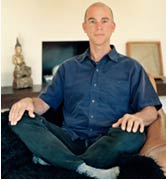
Jamie McHugh. |
|
||||||||||||
| © Copyright Jamie McHugh. All rights reserved. About Jamie | What Is Somatic Expression? | Courses | Calendar | Somatic Expression Articles | Somatic Expression Links | Products | Contact Jamie McHugh | Home |
||||||||||||||||